
Swimming Lessons for Kids in Singapore: What Every Parent Needs to Know (2026)
TL;DR - The Quick Version
Babies can hit the pool from 4 months old. Ages 5–7 are the sweet spot for strokes, but older kids catch up surprisingly fast. Group lessons start from around $100/month at ActiveSG pools, or $120–$200/month at private swim schools. SwimSafer Gold (the one secondary schools care about) takes six stages to reach, so start early. We cover it all below: the right age, what SwimSafer actually involves, how to spot a great swim school, 2026 pricing, your first-class packing list, and water games to practise between lessons.
Singapore is a country surrounded by water, and with condominiums, beaches, and public pools everywhere, the ability to swim is not just a fun skill. It is a life skill.
Yet for many parents, navigating the world of kids swimming lessons can feel overwhelming. What age should you start? What is the SwimSafer programme? Should you choose group or private lessons? And how do you know if a swim coach is actually qualified? Demand for children’s enrichment activities continues to climb year over year, with sports like swimming consistently ranking among the most searched-for classes by parents, and the trend shows no signs of slowing in 2026.
This guide answers all of it, so you can make a confident, informed decision for your child.
Why Swimming is One of the Most Important Skills for Kids in Singapore
Singapore's tropical climate means that water is part of everyday life; condo pools, beach outings, water parks, and school swimming carnivals are all routine. Beyond the fun, the numbers make a clear case for prioritising swimming early.
The SwimSafer programme was introduced precisely to reduce drowning incidents among young people. Learning to swim teaches children how to survive in unexpected water situations, something every child in Singapore should be equipped for.
Beyond safety, swimming delivers a host of developmental benefits:
- Full-body physical exercise that builds cardiovascular fitness, strength, and coordination
- Cognitive development- swimming requires bilateral coordination that supports brain development
- Social skills and confidence through group learning environments
- Discipline and resilience - progressing through structured levels teaches children to persist
- Mental wellbeing - swimming has well-documented effects on reducing stress in children, and many parents report that babies sleep more soundly and feed better after swim sessions
What Age Should My Child Start Swimming Lessons?
The short answer: it is never too early, but the type of lesson matters enormously at different ages.
Babies (4 months to 18 months)
Several swim schools in Singapore offer parent-and-baby classes from as young as 4 months, with some specialist providers like OtterSwim accepting babies from around 6 weeks for gentle water introduction sessions. Newborns are born with natural reflexes, including the dive reflex that causes them to close their airways when submerged, which makes early water exposure surprisingly intuitive. At this stage, the focus is entirely on water familiarisation, not technique. Babies learn to feel comfortable in the water through songs, gentle movement, and parent-guided play. These early sessions also strengthen the parent-child bond through skin-to-skin contact and shared experience in a warm, safe environment. The American Academy of Pediatrics recommends formal swimming lessons from around 1 year of age, but introductory water play from 4 to 6 months is widely supported in Singapore. Look for schools with heated, indoor pools and qualified infant swim instructors with first aid training for this age group.
Toddlers (18 months to 3.5 years)
This is a rich period for water confidence building. Classes are short, play-based, and structured around exploration rather than technique. Expect parent participation to begin fading from around age 2 to 3, depending on the school and the child. Rather than focusing solely on age, look for signs of readiness: can your toddler follow simple instructions, are they generally curious about new experiences, and can they tolerate water on their face without extreme distress? If your toddler screams every time you approach the pool, experienced coaches recommend pausing for a few months and trying again rather than forcing it. Early positive exposure during this period is one of the strongest predictors of swimming success later on.
Preschoolers (3.5 to 5 years)
Most swim schools recommend starting independent lessons from 3.5 years, when children typically have the motor skills and attention span needed for structured instruction. Many swim coaches consider the ages of 5 to 7 the golden window for learning strokes, as children at this stage have sufficient body awareness, lung control for breath holding, and the ability to follow a coach’s instructions. Children begin working on basic strokes, safe water entry and exit, and building confidence in both shallow and deep water. A typical child starting at this age can progress from zero to confident beginner in three to six months of weekly lessons.
Primary School Age (6 to 12 years)
Primary school age is absolutely not too late to begin. In fact, older children often learn faster than younger ones due to better body control, longer attention spans, and the ability to understand and apply technical feedback. Most MOE primary schools run the SwimSafer programme through their PE curriculum. Private lessons during this period are often focused on stroke correction, building distance, and working through the SwimSafer stages formally. An 8 to 12 year old beginner can realistically learn freestyle, backstroke, and breaststroke within six to nine months of consistent weekly lessons.
Understanding the SwimSafer Programme
SwimSafer 2.0 is Singapore’s national water safety and swimming proficiency programme, developed by Sport Singapore and managed by Singapore Aquatics. Designed for children under 16, it goes beyond strokes to teach survival skills, how to stay safe and respond in a real water emergency. The programme is recognised by all schools, institutions, and water-related sports bodies in Singapore.
The 6 Stages of SwimSafer 2.0
- Stage 1: Water confidence, safe entry and exit, forward and backward movement, basic personal water safety.
- Stage 2: Fundamental water skills - unassisted entry, sculling, surface dives. Target: 25 metres of continuous swimming.
- Stage 3: Personal water survival - stride jump, personal flotation device skills. Target: 50 metres.
- SwimSafer Bronze: Stroke development, coordinated breathing in deep water, throw rescue introduction. Target: 100 metres.
- SwimSafer Silver: Diving fundamentals, survival scenarios. Target: 200 metres within a time limit.
- SwimSafer Gold: Advanced survival skills, life jacket use in water, Heat Escape Lessening Posture. Target: 400 metres.
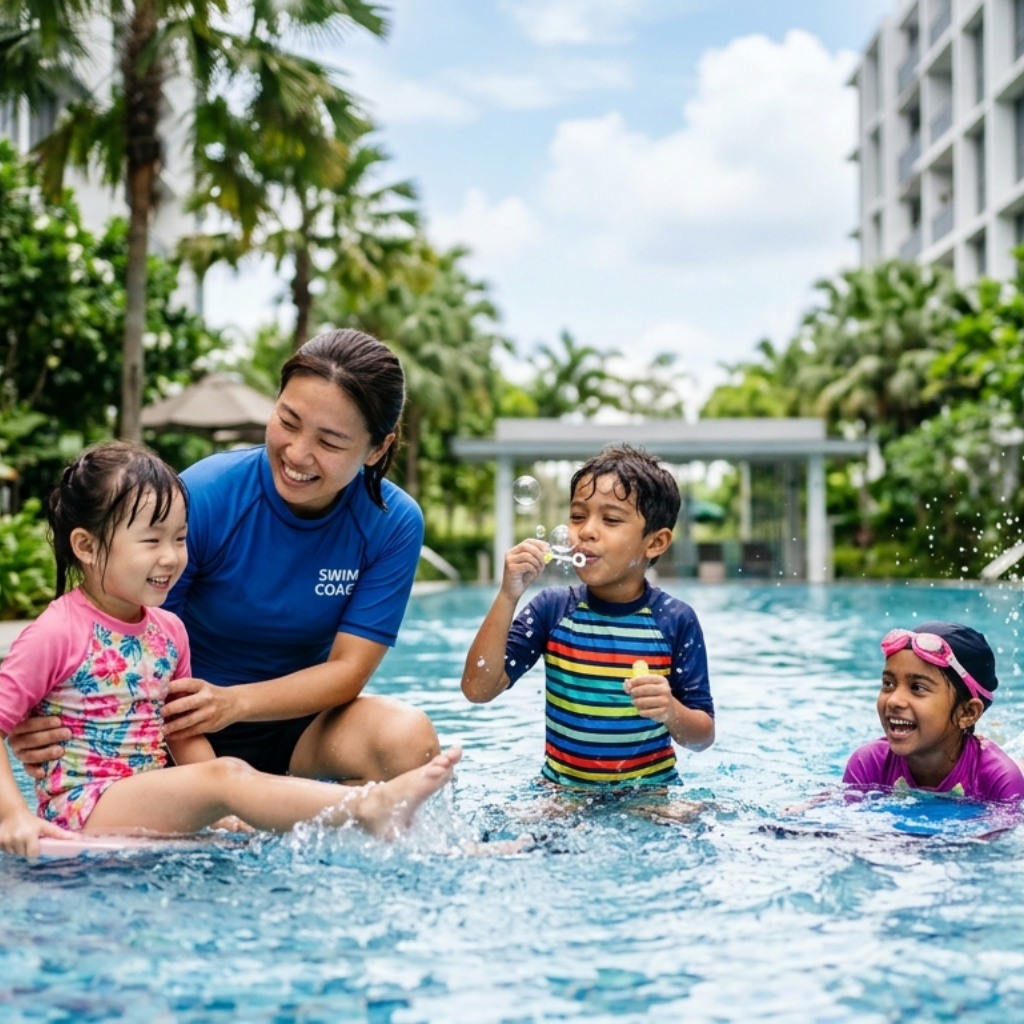
Each stage requires passing a practical assessment and an online theory quiz (minimum 90%), now conducted through the Centralised Assessment Management System (CAMS) managed by Singapore Aquatics.
SwimSafer Gold is the benchmark most MOE secondary schools recognise for PE requirements and is relevant to Direct School Admission (DSA) applications and National Service. Start the journey early working through all six stages takes time, and the skills are life-saving.
What to Look for in a Singapore Swim School
With dozens of swim schools across Singapore, quality varies considerably. Here is your checklist before committing:
- Coach certifications: Look for NROC (National Registry of Coaches), AUSTSWIM, or SSTA certification. Ask to verify credentials.
- SwimSafer accreditation: If formal certification is your goal, ensure the school is an accredited provider recognised by SportSG and Singapore Aquatics.
- Class size: A maximum of 6 to 8 students per coach for group beginner classes is a good benchmark.
- Trial lesson policy: Any reputable school offers a trial class before term commitment. Industry data shows that parents who try before they buy are significantly more likely to commit to a full programme, so a school confident in its quality should welcome this. If they do not offer trials, look elsewhere.
- Transparent pricing: Registration fees, deposits, makeup policies, and SwimSafer assessment fees should all be stated upfront — no surprises.
- Pool environment: Heated pools are ideal for babies and toddlers. For older children, check if the pool is covered and meets safety standards.
- Progress communication: Good schools provide regular updates on your child's progress, not just a term-end report.
How Much Do Swimming Lessons Cost in Singapore? (2026)
Swimming lesson costs in Singapore vary based on format, pool type, age group, and provider. Here is a comprehensive breakdown of current market rates for 2026:
* All prices in Singapore dollars (SGD). Rates are approximate market ranges as of 2026. Always confirm current pricing directly with the swim school.
Notes
- All prices in SGD
- Assumes weekly lessons (4x/month)
- Market ranges; varies by coach experience, location, and demand
Preparing for Your Child’s First Swim Class
A little preparation goes a long way in making your child’s first swim lesson a positive experience. Here is what experienced Singapore parents recommend:
What to pack:
- 🛁 Swim diapers - mandatory at virtually every pool in Singapore (reusable or disposable)
- 👕 Swimsuit or rash guard - especially for outdoor pools; add baby-safe sunscreen if outdoors
- 🧴 Baby body wash + moisturiser - to rinse off chlorine and protect sensitive skin
- 🧹 Two soft hooded towels - one for right after the class, one for post-rinse
- 👜 Change of comfortable clothes - easy to put on a tired, wiggly child
- 🍼 Milk or snack - babies get hungry fast after a swim session
- 💧 Wet bags - for damp towels, swimsuits, and used swim diapers
- 🩱 Your own swimwear - if the class is parent-accompanied (tip: wear it under your clothes to save time!)
Before the lesson:
- 🍜 Feed your child 30–60 minutes before class - not right before, to avoid tummy discomfort
- ⏰ Arrive 15 minutes early - settle in, change, and let your child warm up to the pool environment
- 🌊 For nervous first-timers - a quick splash in the shallow end before the instructor arrives can ease anxiety
After the lesson:
- 🚿 Rinse off promptly - chlorine can dry out sensitive skin fast
- 🧴 Apply a gentle moisturiser - and have a warm towel ready to wrap them up
- 😴 Plan for downtime - babies especially get tired and hungry after swimming, so have a feed and nap ready
Fun Water Activities to Build Confidence at Home
You do not need to wait for formal lessons to start building your child’s water confidence. Between classes, simple water play at home or at the condo pool can reinforce what they are learning and reduce anxiety around water. Try gentle pouring games during bath time to help babies get used to water on their face, blowing bubbles through a straw in a basin of water, playing “catch” with floating toys in the shallow end of the pool, or practising kicking while holding onto the pool wall.
For older children, water games like treasure hunts (retrieving toys from the pool floor), relay races in the shallow end, and “shark and minnow” chase games make practice feel like play. The key is to keep every interaction with water positive and pressure-free. A child who associates the pool with fun will progress much faster in structured lessons. Always supervising children around water, swimming skills in a pool do not guarantee safety, and adult supervision remains essential at all times.
Making the Most of School Holiday Swim Programmes
School holidays in Singapore, particularly the June and December breaks are prime time for swimming intensives. Many swim schools offer holiday programmes where children attend multiple sessions per week, accelerating their progress significantly.
For children preparing for SwimSafer assessments, a holiday swim intensive can be transformative. Two weeks of near-daily 45-minute sessions often delivers more progress than months of weekly classes.
If you are planning ahead for the June 2026 holidays (30 May to 28 June), start looking in April for popular holiday swim programmes as they get sold out weeks in advance.
Ready to find the perfect swim class for your child?
Find a Camp or Class Now!Blogs

Aug 12, 2026
Kids' Birthday Party Venues in Singapore, Sorted by Age Band and Budget
Aug 10, 2026
Things To Do With Kids In Bedok: 18 Parks, Playgrounds And Pools Worth The Trip
Jul 31, 2026
18 Best Things To Do With Kids In Yishun: Playgrounds, Parks, Indoor Play And Family Fun In Singapore's North
Jul 30, 2026
Things to Do With Kids in Punggol, Singapore (2026): The Complete Guide

Jul 28, 2026
Beyond Sassy Mama: Things to Do With Kids in Jurong West, Singapore (2026)
Jul 16, 2026
Things to Do With Kids in Tampines, Singapore (2026)
Jul 15, 2026
Best Chess and Mind Sport Classes for Kids in Singapore (2026)

Jul 13, 2026
New Things to Do With Kids in Singapore in 2026 That Most Parents Have Not Tried Yet
Jul 8, 2026
Best Gymnastics Classes for Kids in Singapore (2026)
Jul 7, 2026
The Best Birthday Party Venues for Kids in Singapore (2026)

Jun 29, 2026
What to Do With Kids in Singapore in July 2026

Jun 25, 2026
Best Baby Sensory Classes in Singapore (2026)
.png)
Jun 22, 2026
Free Things to Do With Kids in Singapore During the June Holidays (2026)

Jun 17, 2026
Holiday Camps in Singapore Under $500: A Complete Guide (2026)

Jun 15, 2026
Week 3 of the June School Holidays in Singapore: A Reset Plan

Jun 8, 2026
What Kids Actually Learn at Holiday Camps (That Parents Do Not Expect)

Jun 2, 2026
Free and Low-Cost Things to Do These June Holidays in Singapore (2026)
Jun 2, 2026
June School Holidays 2026: Week 1 Planner & What's Closing Soon

Jun 2, 2026
June Holidays Singapore 2026: The Week-by-Week Planner

May 26, 2026
Last-Minute June Holiday Camps Singapore 2026

May 22, 2026
Public Speaking and Drama Classes for Kids in Singapore: 2026 Guide

May 21, 2026
What to Pack for Your Child’s First Holiday Camp in Singapore

May 14, 2026
A Guide to Outdoor and Nature Camps for Kids in Singapore

May 14, 2026
A Parent's Guide to Dance Enrichment in Singapore

May 7, 2026
A Parent's Guide to Mother's Day Activities in Singapore

May 5, 2026
A Guide to Children's Language Enrichment in Singapore

May 4, 2026
June School Holidays 2026 Singapore: Holiday Camp Guide

Apr 28, 2026
Cooking and Baking Classes for Kids in Singapore

Apr 27, 2026
A Parent's Guide to Sports Enrichment in Singapore (2026)

Apr 22, 2026
How to Choose the Right Enrichment Class for Your Child

Apr 16, 2026
From Toddler Sensory Play to Fine Art Mastery

Apr 15, 2026
Singapore Music Lessons: A Parent's Guide
Apr 9, 2026
Singapore Kids Swimming Lessons: A 2026 Parent Guide
Apr 8, 2026
The Best Kids Holiday Camps in Singapore (2026 Guide)

Mar 26, 2026
2026 Singapore School Holidays: Complete Calendar for MOE & International Schools

Nov 14, 2025
Best Martial Arts Classes for Kids in Singapore: Taekwondo, Jiu-Jitsu & More

Nov 7, 2025
STEM, Coding & Robotics: The Best Tech & Science Programs for Kids in Singapore

Oct 31, 2025
Top Gyms and Movement Classes in Singapore for Babies, Toddlers, and Young Kids

Oct 24, 2025
Act, Sing, Dance at Top Performing Arts Programs for Children in Singapore

Oct 17, 2025
Where Kids Can Move & Groove: Best Dance Classes for Kids in Singapore

Oct 10, 2025
Learn Beyond the Classroom: Hard Skills, Soft Skills, Fun Skills and More For Kids

Oct 3, 2025
Indoor & Outdoor Fun For Kids in Singapore

Sep 26, 2025
Fun & Free Kid Friendly Activities in Singapore

Sep 22, 2025
Nature Activities & Experiences for Kids in Singapore

Sep 19, 2025
Best Indoor Playgrounds & Classes for Kids in Singapore

Sep 12, 2025
Best Arts & Crafts Classes for Kids in Singapore

Sep 10, 2025
Halloween Swimming Camp Singapore: Spooktacular SWISH Camp at Dempsey Hill (Ages 4-14)

Sep 9, 2025
Singapore School Holiday Camps: Water Trekkers & Mighty Troopers Adventures at NTUC Outdoor School

Sep 3, 2025
Active Learning Holiday Camp: Boxing + Multi-Activity STEAM Fun in Singapore

Aug 25, 2025
Upcoming School Holiday Camps in Singapore for Kids (Sept & Oct)
Aug 13, 2025
5 Hidden Gems in Singapore for Kids’ Activities
Aug 11, 2025
Top Indoor Activities in Singapore for Rainy Days

Aug 4, 2025
SG60 Promotions: Family-Friendly Activities at Special Prices

Jul 17, 2025
Dive In: The Best 3 Swim Camps in Singapore This Season
Jul 13, 2025
Budget-Friendly Summer Camps in Singapore: Fun Without Breaking the Bank

Jul 7, 2025
Creative Arts Summer Camps in Singapore for Budding Artists and Performers
Jul 3, 2025
Sports and Adventure Summer Camps in Singapore to Keep Your Kids Active

Jul 1, 2025
A Look Back at Jungle’s Launch Promos
Jun 30, 2025
STEM Summer Camps in Singapore for Tech-Savvy Kids
Jun 26, 2025
Summer Camps in Singapore by Location: Finding a Camp Near You
Jun 19, 2025
Last-Minute Summer Camp Options in Singapore for Busy Parents

Jun 12, 2025
How to Choose the Best Summer Camp in Singapore for Your Child
The Friday edit.
Weekend picks, holiday camps with remaining spots, and the odd story from parents we talk to.